The Famous Outfits style guide
Men’s Peacoat Outfits
A men’s peacoat works with straight jeans or chinos, a shirt or medium-weight knit, and shoes suited to the occasion. Keep the double-breasted coat roomy enough to close over your layers, and let the trousers fall cleanly over the shoe. Navy is an easy first color; camel and black give you different contrast and formality.
By Famous Outfits · Updated September 27, 2026

Start here
How should men wear a peacoat?
A men’s peacoat works with straight jeans or chinos, a shirt or medium-weight knit, and shoes suited to the occasion. Keep the double-breasted coat roomy enough to close over your layers, and let the trousers fall cleanly over the shoe. Navy is an easy first color; camel and black give you different contrast and formality.
Colors to pair with a peacoat
Start with coat color, then choose trousers and shoes that create a clear break at the hem. Navy is the easiest anchor; camel needs contrast, and black can make a sharper tonal outfit.
Navy
A versatile coat shade with denim, gray, stone and cream.
Try it: Navy peacoat + blue Oxford + dark indigo jeans
Camel
Adds warmth; ground it with dark denim, navy or charcoal.
Try it: Camel peacoat + cream knit + dark jeans
Black
Works with black, charcoal and dark denim for a sharper line.
Try it: Black peacoat + charcoal knit polo + black trousers
Cream
Softens dark coats and adds a clear layer at the neckline.
Try it: Navy peacoat + apricot cable knit + stone chinos
Blue
Connects navy outerwear to denim without an all-dark outfit.
Try it: Navy peacoat + blue Oxford + brown shoes
Olive
An earthy trouser shade that offsets camel and navy.
Try it: Camel peacoat + blue Oxford + olive chinos
Charcoal
A quieter alternative to black beneath dark outerwear.
Try it: Black peacoat + charcoal polo + black loafers
Ecru
Brings light contrast below camel or black outerwear.
Try it: Black peacoat + light knit + ecru jeans
Use the coat as the outfit’s frame
A peacoat has broad lapels and a double-breasted front, so the coat already supplies structure. Keep the visible shirt or knit simple. A neat collar or crew neck usually sits more comfortably than a thick hood or bulky scarf crowded under the lapels.
Set up contrast at the coat and hem
Navy and dark denim can look continuous; a pale shirt, lighter trousers or brown shoes can separate them. Camel stands out against navy, charcoal and dark indigo. Black pairs naturally with dark pieces, while ecru jeans give it a sharper light-dark contrast.
Respect the coat’s length and weight
The traditional peacoat is shorter than an overcoat and has enough visual weight to anchor casual or smart-casual clothes. Straight jeans and chinos work easily. For a suit, test shoulder and sleeve room; a longer overcoat may sit more cleanly over tailored layers.
6 men’s peacoat outfits for different plans
Use the formulas as a starting point and substitute pieces you already own. Each combination has a different job, from a relaxed weekday to an occasion that calls for tailoring.
Compare the outfits at a glance
| Outfit | Best for | The formula |
|---|---|---|
| Navy peacoat with blue Oxford and dark jeans | Smart casual • office & lunch | Dark navy double-breasted peacoat + blue Oxford shirt + rinse-indigo straight jeans + brown leather Oxfords |
| Navy peacoat with an apricot knit and stone chinos | Weekend • museum & dinner | Dark navy double-breasted peacoat + apricot cable-knit sweater + stone straight chinos + coffee suede loafers |
| Camel peacoat with a cream tee and dark denim | Casual • weekend errands | Camel double-breasted peacoat + cream crew-neck tee + rinse-indigo straight jeans + off-white canvas sneakers |
| Camel peacoat with a blue Oxford and olive chinos | Smart casual • city plans | Camel double-breasted peacoat + blue Oxford shirt + olive straight chinos + matte coffee leather chukka boots |
| Black peacoat with a charcoal polo and black trousers | Dinner • polished casual | Black double-breasted peacoat + charcoal rib-knit polo + black flat-front trousers + black penny loafers |
| Black peacoat with an apricot knit and ecru jeans | Casual • gallery & coffee | Black double-breasted peacoat + apricot cable-knit sweater + ecru straight jeans + brown suede loafers |
As an Amazon Associate, Famous Outfits earns from qualifying purchases. Shop similar pieces to recreate each look; the photos do not depict the exact linked products. Check your size, color, and current price on Amazon.

01 / Smart casual • office & lunch
Navy peacoat with blue Oxford and dark jeans
Dark navy double-breasted peacoat + blue Oxford shirt + rinse-indigo straight jeans + brown leather Oxfords
The neat Oxford and brown leather shoes make dark denim feel considered without trying to pass as a suit. Keep the blue shirt lighter than the coat, and allow enough room through the shoulders to button over it. Straight jeans balance the short coat while keeping the outfit comfortable for a full day.
Make it yours. For a more relaxed day, replace the Oxford with a plain tee and the dress shoes with clean trainers. If the coat feels tight when buttoned, reduce the layer bulk or try another size rather than forcing the front closed.
Shop this outfit 4 pieces
 NauticaDark navy double-breasted peacoatDark navy wool-blend, double-breasted peacoat; choose your size.View on Amazon
  Amazon EssentialsBlue Oxford shirtBlue; regular fit with a button-down collar.View on Amazon
  GAPDark indigo straight jeansRinse Washed Indigo; straight fit. Select your waist and inseam.View on Amazon
  Bruno MarcBrown leather dress shoesBrown; a cap-toe dress-shoe alternative to the pictured Oxfords.View on Amazon

02 / Weekend • museum & dinner
Navy peacoat with an apricot knit and stone chinos
Dark navy double-breasted peacoat + apricot cable-knit sweater + stone straight chinos + coffee suede loafers
A lighter knit and trousers make the navy coat stand out, while the loafers keep the finish tidy. The apricot knit adds a warm note between the navy coat and stone trousers. Wear a thin base layer to preserve comfortable shoulder movement.
Make it yours. A white or pale blue shirt can replace the knit indoors. If you choose a thicker sweater, try it under the coat before buying and check that the lapels still lie flat.
Shop this outfit 4 pieces
- NauticaDark navy double-breasted peacoatDark navy wool-blend, double-breasted peacoat; choose your size.View on Amazon
 PJ PAUL JONESApricot cable-knit sweaterApricot; warmer than cream, with a soft warm contrast under navy and black coats.View on Amazon
  Amazon EssentialsStone straight chinosStone; select your waist and inseam.View on Amazon
 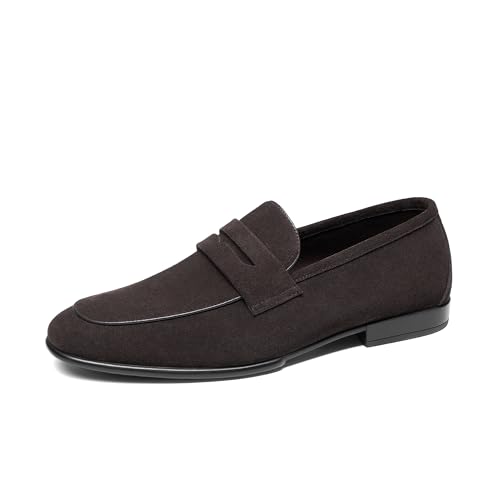 Bruno MarcBrown suede loafersCoffee suede; choose your usual loafer size.View on Amazon

03 / Casual • weekend errands
Camel peacoat with a cream tee and dark denim
Camel double-breasted peacoat + cream crew-neck tee + rinse-indigo straight jeans + off-white canvas sneakers
The simple tee keeps the camel coat from feeling overly formal, and dark denim provides a clear anchor beneath it. The off-white sneakers soften the outfit for casual plans. Leave the coat open indoors and close it outside only if it sits comfortably over the tee and any light midlayer.
Make it yours. On colder days, use a fine crew-neck sweater instead of adding a bulky hoodie. This outfit is casual; choose leather shoes and a collared shirt when the setting calls for a more polished finish.
Shop this outfit 4 pieces
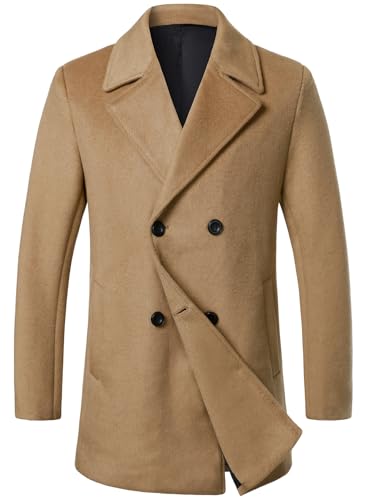 HOOD CREWCamel double-breasted peacoatCamel wool-blend double-breasted pea coat; choose your size.View on Amazon
 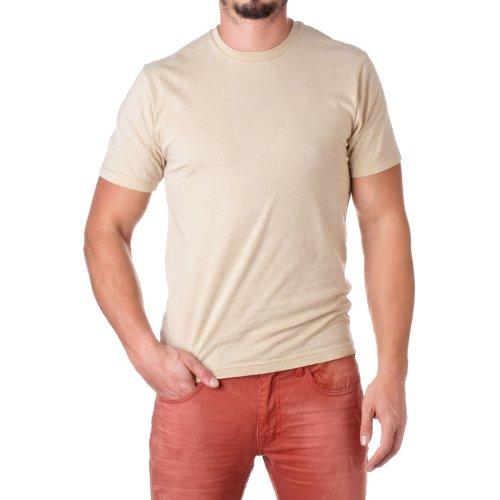 Next LevelCream crew-neck teeCream; a fitted tee rather than a relaxed cut.View on Amazon
 - GAPDark indigo straight jeansRinse Washed Indigo; straight fit. Select your waist and inseam.View on Amazon
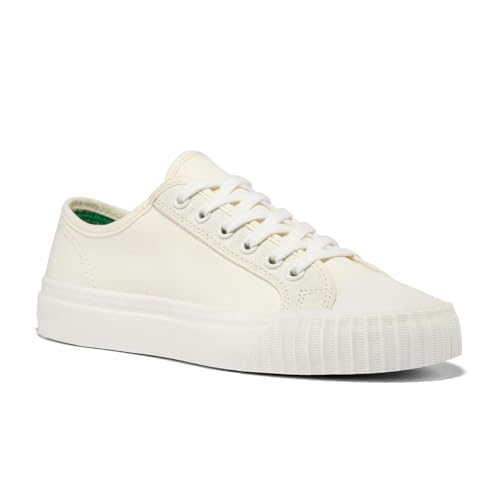 PF FlyersOff-white canvas sneakersSea Salt / off-white; check the unisex size conversion.View on Amazon

04 / Smart casual • city plans
Camel peacoat with a blue Oxford and olive chinos
Camel double-breasted peacoat + blue Oxford shirt + olive straight chinos + matte coffee leather chukka boots
Camel and olive make a muted warm pairing, while the blue shirt adds a cooler color near the face. The brown chukkas connect to the coat without exactly matching it. This combination suits a casual office, lunch or a day in town when heavier outerwear makes sense.
Make it yours. If the colors feel too earthy together, switch the olive chinos to navy or dark denim. Let the trouser hem skim the chukka shaft without catching at the top.
Shop this outfit 4 pieces
- HOOD CREWCamel double-breasted peacoatCamel wool-blend double-breasted pea coat; choose your size.View on Amazon
- Amazon EssentialsBlue Oxford shirtBlue; regular fit with a button-down collar.View on Amazon
 Amazon EssentialsOlive straight chinosOlive; select your waist and inseam.View on Amazon
  ArkbirdBrown leather ankle bootsMatte Coffee; a shorter chukka alternative to the pictured boots.View on Amazon

05 / Dinner • polished casual
Black peacoat with a charcoal polo and black trousers
Black double-breasted peacoat + charcoal rib-knit polo + black flat-front trousers + black penny loafers
The charcoal polo separates the coat from the black trousers without interrupting the tonal line. Use this for dinner or a polished casual event, not as a replacement for formal eveningwear. A flat front and clean shoe keep the shorter coat’s shape intentional.
Make it yours. A pale blue or white shirt creates stronger contrast if head-to-toe dark feels too severe. Check the trousers while walking so the hem does not pool on top of the loafers.
Shop this outfit 4 pieces
 NauticaBlack double-breasted peacoatBlack wool-blend, double-breasted peacoat; select your size.View on Amazon
  COOFANDYCharcoal knit poloCharcoal grey; ribbed knit with a three-button collar.View on Amazon
  Amazon EssentialsBlack dress trousersBlack; classic fit, flat front, expandable waist.View on Amazon
  RockportBlack penny loafersBlack II; choose your size and width.View on Amazon
06 / Casual • gallery & coffee
Black peacoat with an apricot knit and ecru jeans
Black double-breasted peacoat + apricot cable-knit sweater + ecru straight jeans + brown suede loafers
Light trousers give the black coat a clear break and make the outfit feel less formal. The warm apricot sweater bridges the dark top and ecru denim; the brown loafers keep it relaxed. This is an indoor-to-outdoor combination for cool, dry days rather than a severe-weather uniform.
Make it yours. Use dark jeans if you prefer less contrast, but keep a lighter shirt or sweater visible under the coat. Check light denim for opacity and choose a shoe with a sole suited to your route.
Shop this outfit 4 pieces
- NauticaBlack double-breasted peacoatBlack wool-blend, double-breasted peacoat; select your size.View on Amazon
- PJ PAUL JONESApricot cable-knit sweaterApricot; warmer than cream, with a soft warm contrast under navy and black coats.View on Amazon
 MadewellEcru straight jeansEcru; 1991 straight-leg style.View on Amazon
 - Bruno MarcBrown suede loafersCoffee suede; choose your usual loafer size.View on Amazon
Build a small wardrobe that mixes easily
Build around a double-breasted coat that fits over your real winter layers. One coat can move between denim, chinos and smarter trousers when the supporting pieces suit the setting.
Outer layer
Navy, camel or black double-breasted peacoat
A distinct color choice changes the contrast while the short tailored shape remains useful.
Shirts
Blue Oxford and cream tee
One collared and one simple option cover smart-casual and relaxed outfits.
Knitwear
Medium-weight cable-knit sweater
Adds warmth without needing several bulky layers under the coat.
Trousers
Dark jeans, stone or olive chinos, and ecru denim
Different values and textures help the coat read clearly.
Shoes
Brown leather shoes, suede loafers, clean trainers and black loafers
Match the finish to the outfit’s formality and expected walking conditions.
Fit check
Try-on over your real cold-weather layers
Confirms shoulder room, button closure and sleeve movement before the tags come off.
Before buying, make three combinations from the pieces on your list. If a new shirt only works with trousers you do not own, it may be less useful than a replacement for something you wear every week. Fabric care and comfortable fit deserve as much attention as color.
Wear a peacoat through cool-weather seasons
The coat’s wool blend and lining determine warmth; the name alone does not promise weather protection.
Autumn: start with a shirt or light knit
A peacoat over an Oxford, tee or thin sweater gives room to adjust as the day changes. Navy and camel work easily with dark jeans and chinos. Carry a compact umbrella when rain is expected because wool blends are not automatically waterproof.
Winter: layer thin before adding bulk
Wear a thermal or fine knit under the coat before stacking several thick sweaters. Check that the double-breasted closure lies flat when fastened. Pair it with warm socks and footwear with appropriate grip when sidewalks are icy.
Spring: use the coat as a removable top layer
A lighter shirt and chinos keep the outfit balanced when temperatures vary. If the peacoat feels too warm by midday, choose a lighter jacket rather than tying the heavy coat around your waist.
Choose the right peacoat fit and length
Check shoulder and back movement
The shoulder line should sit naturally, and reaching forward should not pull the back tight. Try it over the thickest layer you plan to wear. A close fit that works over a tee can be too restrictive over knitwear.
Test the double-breasted front
Fasten the coat and stand, sit and move your arms. Buttons should not pull into diagonal wrinkles, and the lapels should stay flat. If the front strains, try a different size or wear a thinner layer.
Match length to the clothes beneath
A traditional peacoat ends around the hip or upper thigh, shorter than most overcoats. It works naturally with jeans and chinos. If a suit jacket extends below the coat or bunches under it, choose a longer overcoat instead.
Keep the collar area comfortable
The broad lapels frame the shirt or knit, so avoid stacking a high bulky hood and scarf beneath them. A fine scarf can sit over the lapels when needed, as long as it does not obstruct movement or vision.
Fix common peacoat outfit problems
The front pulls when buttoned
Reduce the midlayer bulk or try the next size. Do not leave distorted lapels and strained buttons as proof of a tailored fit; the coat should close comfortably.
The navy coat and dark jeans blend together
Add a lighter shirt, stone chinos, or a visible brown shoe. You can also use different textures, such as a smooth wool coat over denim.
Camel looks too close to the trousers
Use navy, dark denim or charcoal below the coat. A blue or cream layer near the face can create another point of contrast.
The coat feels too dressy with sneakers
Keep the rest of the outfit simple and the trainers clean. If the occasion is more formal, trade the tee and sneakers for a collared shirt and leather shoes.
Men’s peacoat questions
A few useful answers before you choose your next outfit.
What is a peacoat?
A classic peacoat is a short, substantial coat with a broad notched lapel and a double-breasted front. Traditional naval versions often use dark wool and large buttons. Modern listings vary in fabric and length, so check the construction and product photos instead of relying on the name alone.
What should I wear with a navy peacoat?
Navy works with dark indigo denim, gray or stone chinos, cream knits and pale blue shirts. Keep a visible difference between the coat and trousers so the outfit does not become one solid block. Brown shoes warm it up; black shoes make the result more formal.
Can you wear a peacoat with jeans?
Yes. Straight dark jeans, a simple knit or Oxford shirt and clean boots or leather shoes make an easy everyday outfit. Let the hem sit cleanly at the ankle and keep the denim slim enough to balance the coat without restricting movement.
Are peacoats formal or casual?
They sit between casual outerwear and tailored coats. Wool, clean buttons and a neat shoulder can make a peacoat feel polished, while a chunky knit and denim keep it relaxed. A peacoat is not a substitute for a formal overcoat at black tie or a conservative business event.
How should a peacoat fit?
The shoulder seam should sit near your shoulder, and the coat should close comfortably over the layers you actually wear. Check reach, button strain, collar position and room across the back when you move your arms. Avoid sizing down until the double-breasted front pulls or the lapels spread.
Should a peacoat be buttoned?
Button it when you want warmth or a defined shape; leave it open over lighter layers when the weather allows. If a buttoned front pulls or the lapels distort, the coat may be too small or your layer too bulky. Follow any closure instructions for the specific coat.
What color peacoat is most versatile?
Navy is a flexible first choice because it works with denim, gray, cream, olive and many brown accessories. Black is sharper with dark trousers, and camel adds warmth but needs some contrast near the face and below the waist. Choose a shade that fits your existing clothes.
Can I wear a peacoat over a suit jacket?
Only if the coat has enough room in the shoulders and sleeves to cover the suit without bunching or pulling. Try both pieces on together and check the lapels and back when you reach forward. A longer overcoat is often easier over formal tailoring.
What pants look best with a camel peacoat?
Navy, dark indigo, charcoal, olive and deeper brown create useful contrast with camel. Stone or ecru can work if the top under the coat is darker and the shoe separates from the trouser hem. Check the whole outfit in daylight so the light pieces do not merge.
Can a peacoat be worn in rain or snow?
Do not assume a wool-blend coat is waterproof. Check the garment care and fabric details, and use a weather shell or umbrella in steady rain. For snow and ice, pair it with warm layers and footwear with suitable traction; the coat itself does not make shoes safe.
What can I wear under a peacoat?
A shirt, medium-weight crew-neck knit, or thin sweater over a tee usually fits more cleanly than several bulky layers. Test the coat over the thickest outfit you plan to wear. You should be able to move your arms and close it without the front pulling.
How do I care for a wool-blend peacoat?
Read its care label first. Brush away surface lint, hang it on a broad sturdy hanger and air it between wears. Spot clean only if the label allows, and use the stated professional cleaning method when needed. Empty the pockets before storage so the shoulders do not sag.

Save your next outfit idea
Build a Pinterest board around combinations you would actually wear. Save a whole outfit, then note the piece you already own and the one you would change. Over time, repeated colors and shapes will make your personal style easier to see.
Make the palette your own
Start with a double-breasted coat that closes comfortably over the layers you wear most. Navy is the easiest first color; camel and black create different contrasts. Pair it with straight trousers, simple knitwear and shoes that suit the setting, then adjust the hem and layers until you can move naturally.
Keep building your wardrobe

Rainy-Day Outfits for Men: 6 Practical Ways to Dress
Six complete rainy-day outfits for men, with waterproof footwear, useful layers and clear advice on showers versus sustained rain.

Horizontal Stripes for Men
Six men’s horizontal-stripe outfits with sweaters, tees and a rugby shirt, plus practical advice on colors, fit and layering.

Denim on Denim for Men: 6 Double-Denim Outfit Ideas
Six complete double-denim outfits pairing jackets or shirts with jeans in contrasting washes, plus practical fit, color and care advice.